Showing posts with label Archaeology. Show all posts

Wednesday, April 27, 2016

Pompeii: The Underbelly of the Ruins

By Bethany Youngblood

Photo: Sophie Hay (http://www.dayofarchaeology.com/author/sarahhay/)

We know that Pompeii was the site of one of the most memorable losses of life in the ancient world. But was it merely a natural disaster without cause? Could a literal writing on the wall shed light on what this doomed culture was like before it was buried alive? Is it possible that their own actions brought on the consequence of judgment just like the biblical cities of Sodom and Gomorrah?

Wednesday, September 10, 2014

Who were our Human Ancestors?

by Brian Mariani
Model of Neanderthal Man, at one time thought to be human ancestors
http://www.theguardian.com/science/2013/feb/04/neanderthals-modern-humans-research
Were our early ancestors ape-like creatures and dumb cavemen or were they fully formed human beings created intelligently? Why do people think humans evolved from animals?

While an evolutionist would defend the ape-to-human evolution paradigm, citing various pieces of “evidence” throughout history and describing multiple transitional species along the long journey to homo sapiens, we believe that the correct interpretation of Scripture rules out all that conjecture.

Thursday, August 7, 2014

Derinkuyu: City Beneath Our Feet

By Analea Styles

http://travellerguide.asia/turkey-tourism-the-incredible-underground-city-of-derinkuyu.html
It’s not everyday you hear about entire cities built thousands of years ago, boasting sophisticated architecture, design, and careful organization – underground! Derinkuyu, a massive subterranean city that could have housed up to 20,000 people, is literally a mine for unearthing evidence of ancient genius.

Wednesday, October 23, 2013

Gobekli Tepe: The Buried Temple

 By Bethany Youngblood
Gobekli Tepe
http://www.world-archaeology.com/features/turkey-gobekli-tepe/ 

The semi-deserts of southeastern Turkey seem very uninviting. Yet archaeologists flock there like the sheep that graze the valleys between the dusty plateaus, to feast their eyes on something that has changed their view of humanity’s advancement. A gently rounded hill rises above the surrounding landscape. What lies within this hill is what has attracted all the attention. A shepherd was the first to discover the top of a pillar jutting up out of the dirt and introduced the site to archaeological curiosity. But it was a German archaeologist named Klaus Schmidt in 1994 who ‘unveiled’ the incredible importance of this hill known as Gobekli Tepe. [1]

Wednesday, September 11, 2013

Nan Madol: Another Site of Mystery

By Brian Mariani

David Astley: http://www.pbase.com/image/83742062
Imagine a city built on the ocean and rising up high over the surface of the water. This was Nan Madol.

Wednesday, August 21, 2013

Henges: Commonalities Across the Globe


By Sarah Ann Rowen
"Ales Stenar", Sweden's stone circle
http://www.nbcnews.com/id/47102902/ns/technology_and_science-science/t/swedish-stonehenge-well-thats-debatable/#.UhO6cs1JuJY
Shrouded in mystery, henges have captured the attention of millions of people around the world. Whether one has a casual tourist-minded interest, a curious, investigative mind, or an intense desire to research and discover their purpose, these sites appeal to almost anyone.

Wednesday, April 17, 2013

The Minoan Civilization: Proof of Advanced Nature

By Matthew Zuk

Palace of Knossos - Photo by Ken Zuk


The Minoan civilization is one of the most advanced ancient civilizations ever discovered. They are by far the most advanced discovered thus far in Europe (only La Bastida comes close). They were primarily located on the island of Crete. The technological advancements of their structures are at least a thousand years ahead of their time. It is believed that their civilization rose around 2200 BC, not long after the dispersion at Babel. They reached the pinnacle of their power from 1900 to roughly 1400 BC, when they disappeared extremely rapidly (reasons for their demise will be explained in a future blog post). During their time they were the powerhouse of the Mediterranean Sea, and among the most powerful civilizations of the ancient world.[1]

Wednesday, March 20, 2013

La Bastida: Europe’s Most Formidable City

 By Matthew Zuk

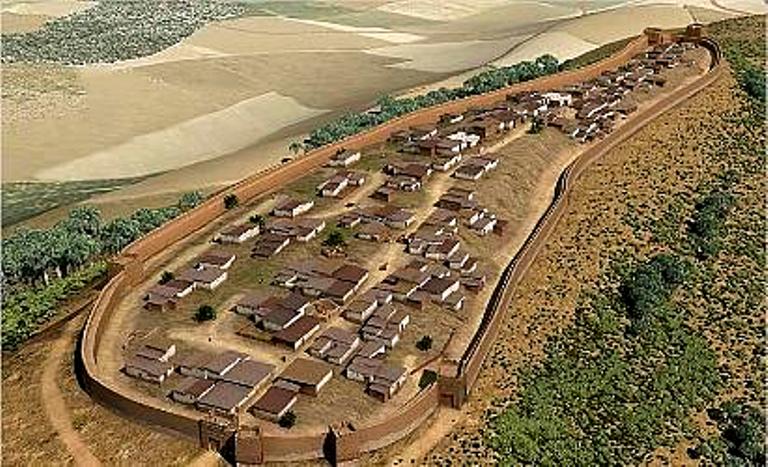
Artist's depiction of La Bastida
http://www.aroundtheworldineightyyears.com/wp-content/uploads/2013/02/labastida.jpg


La Bastida, recently discovered, is among the oldest cities found in Europe.[1] The city is one of the most noteworthy ancient sites found in recent years and is incredible proof of ancient man’s highly advanced and developed society. Archaeologists have discovered many characteristics of the city that lend significance to this site including the military aspect of the fortress, the incredible architectural achievements, and its location and influences.

Wednesday, March 6, 2013

"Cruising" through Mayan Ruins

By Caleb Berumez

Setting Out


On the morning of December 5th, 2010, fifty-five individuals from all over the United States left a hotel in Miami and headed down to the dock where they boarded a ship bound for the Yucatan Peninsula.  The first Jackson Hole Bible College Ancient Man Cruise was underway.

Pastor Don Landis of Community Bible Church opened our first full day of sailing with a morning chapel service.  It was quickly decided that, while beautiful, the Skylight Chapel on the highest deck amplified the motion of the ship.  The conference room we had been provided with (near the center of the ship) was set as our future meeting room for subsequent chapels.

Later that morning and in the afternoon, Pastor Don and Mike McCurdy gave lectures on the research that was being compiled by the Ancient Man Project.